MIRROR.MIRROR.
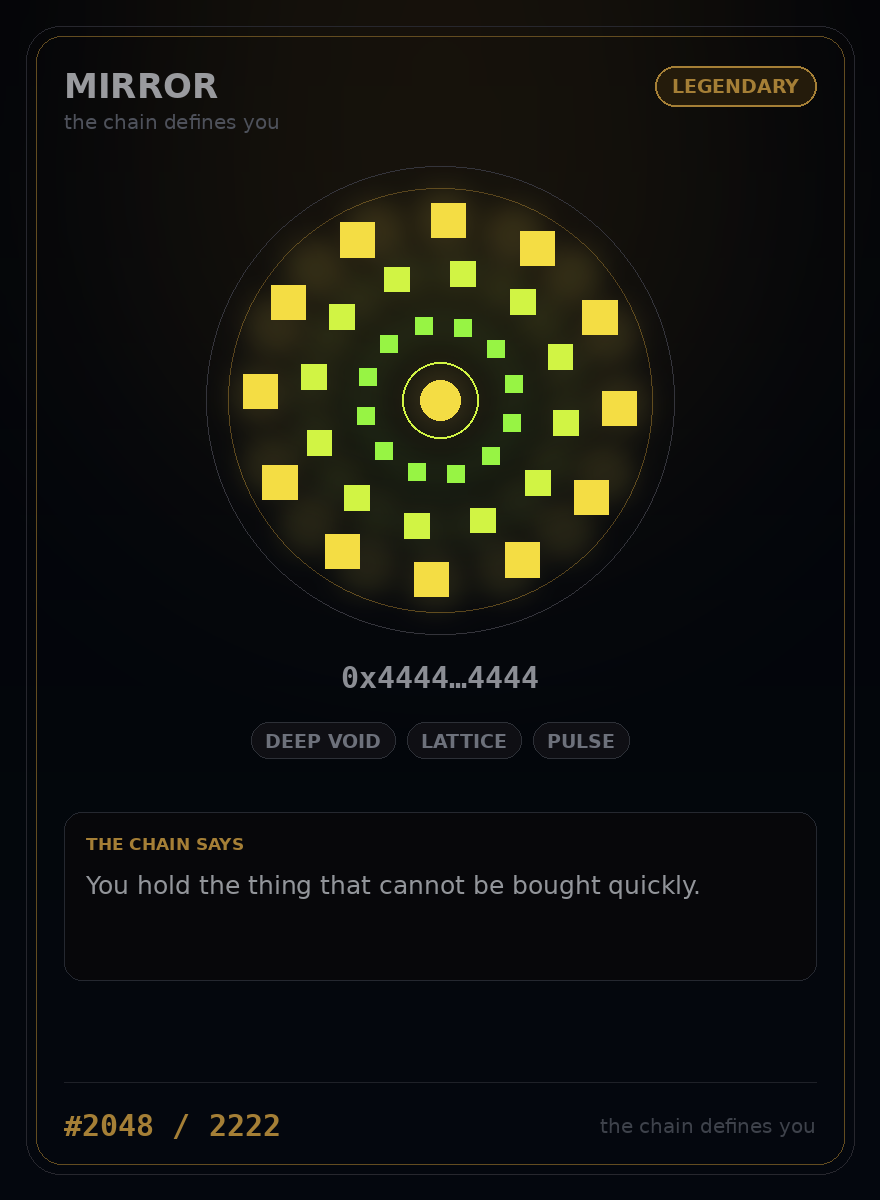
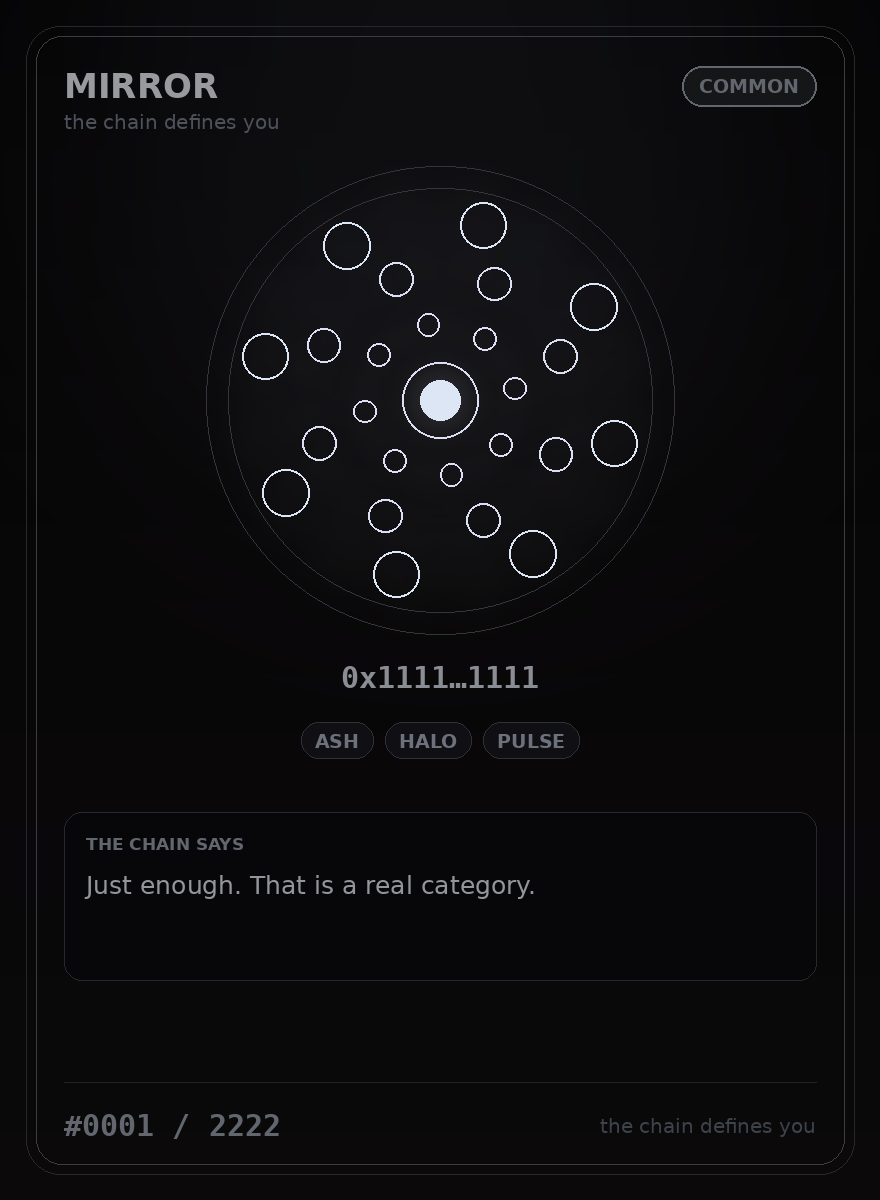
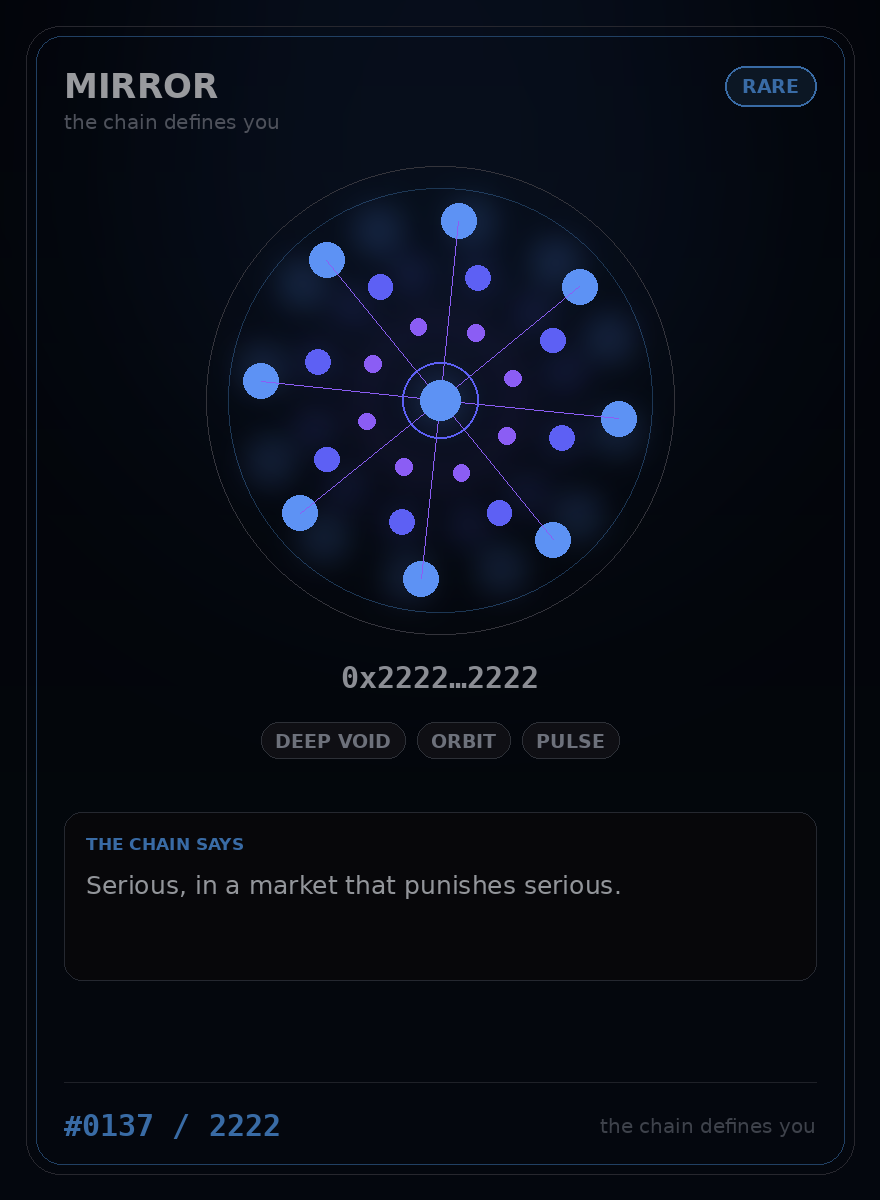
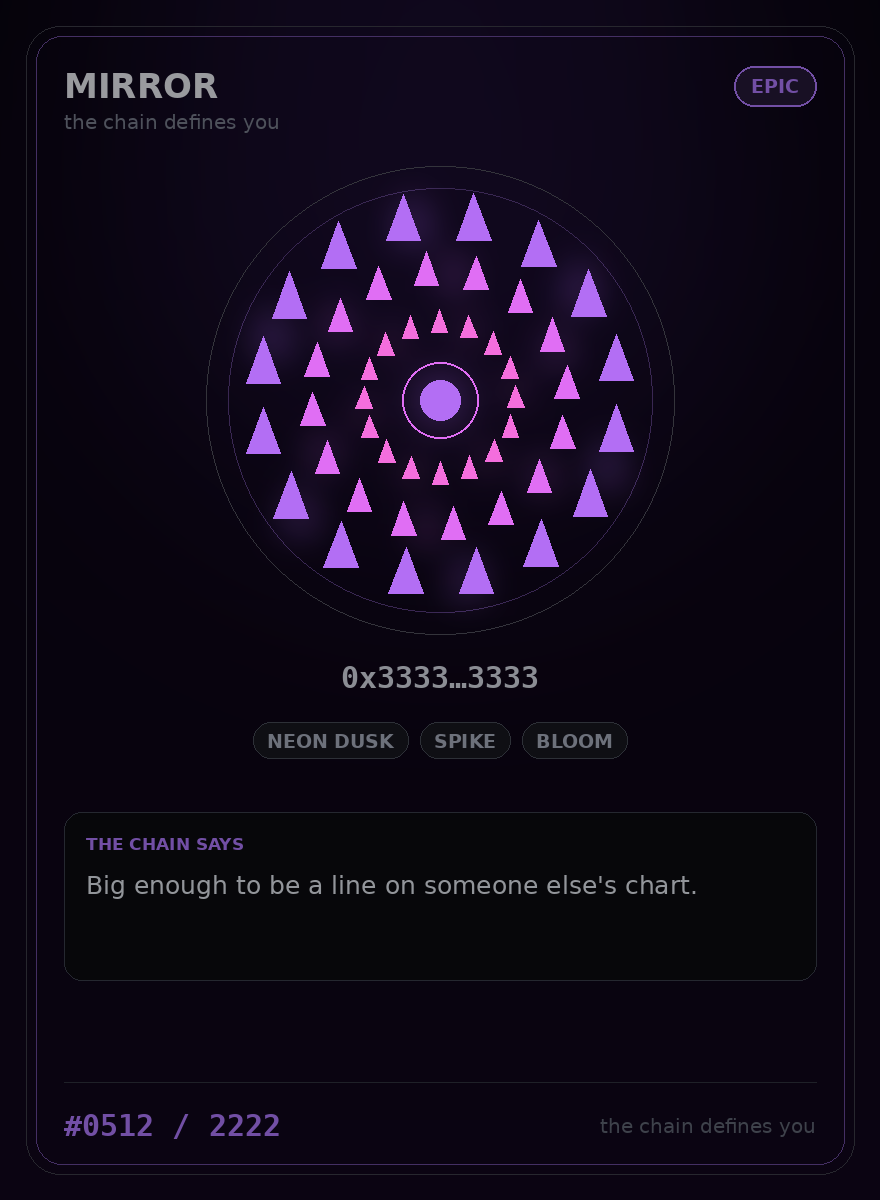
Paste any address. The card it gets is read off the chain —
never drawn at random, never chosen, never sold.
3228 exist — 3000 claimable by holders, 228 held back as a reserve.
Mint is live. Free if you held identity.md or 10 $IMD when the
list was frozen (Oct 7–13) — 5885 wallets are on it.
The verdict is bucketed by what the wallet actually holds, then picked once and frozen. Same wallet, same line, forever — and a different wallet gets a different one. Paste your own above.
Ten tickets, 0.2 $IMD each. When the tenth sells, anyone can trigger the draw, and the ten seats split three ways:
A won mirror is not a chosen one. It still reads your wallet. Win with nothing and you get COMMON, exactly as you would have on the way in.
The four allocation seats. $MIRROR does not exist yet. The win is written into the contract the moment it happens — who won, and how many: none yet. No token moves today, and none can be minted here. What the contract guarantees is the record; the terms are set when the token is actually launched.
Where the money goes. Each round is 2.00 $IMD in — ten tickets at 0.20 each. 1.00 $IMD is the five refunds, paid by the contract, not by us. The other 1.00 $IMD — half the pot — is the project's fee for running the campaign. It is paid to the project wallet, a wallet we control, and we collect it like any other payment. The contract itself cannot move it, and every ticket it was paid for stays valid either way.
It ends. Two gates, and both of them are rules in the contract rather than sentences in this paragraph. The first is the supply: tickets keep selling until the public 3000 are gone — free claims and lottery seats draw on the same pile, and the 228 reserve is ours alone, so it competes with nobody. The second is a count: three thousand rounds, written into the code as MAX_ROUNDS. Three thousand rounds run, and the next one is not sold to anyone, whatever supply is left. A lottery with a visible end is a different thing from one that runs forever, and we would rather it be the first.
Worth knowing: a full round of tickets costs 2.0 $IMD against a 10 $IMD gate and half comes back as refunds, so a ticket is a cheaper route in than the gate — and it stays open for exactly as long as there is something left to win.
Who draws it. Nobody is paid to call the draw, and until somebody does, the round does not advance — the next round cannot sell a single ticket. So the draw button is open to anyone, and the person with the best reason to press it is the person who wants to keep playing. It costs them a little gas and takes about twenty seconds. We run a bot as a backstop, but it waits for cheap gas, because a draw that costs more than the round earns is worse than letting the round expire and refund everyone.
Honest limits. It binds to a wallet, not a person. The draw must run within 256 blocks of the round filling; miss it and anyone can rescue the round, refunding every seat. This is not Chainlink VRF.